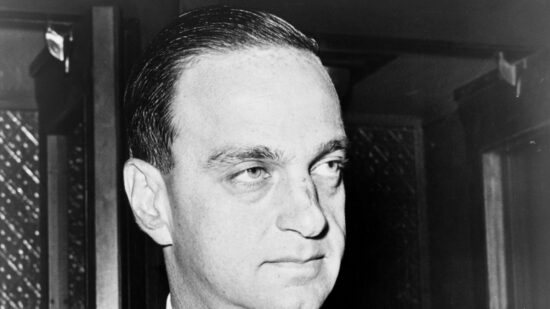
The notoriously pugnacious Roy Cohn was a master manipulator and larger-than-life figure who first came to national prominence in the 1950s as Joe McCarthy’s ruthless attorney, and managed to keep himself in the spotlight for most of his life as a radical right-winger with seamy mob connections and an underworld clientele.
Cohn, a closeted homosexual who was at the center of McCarthy’s persecution of gay federal employees in what came to be called the Lavender Scare, died of AIDS on August 2, 1986.
American Scoundrel
Today, Roy Cohn is mostly remembered for his influence as mentor and attorney to a young Donald Trump. If Cohn’s former protégé hadn’t ascended to the presidency, might we have forgotten him? That would be a mistake, argues Pulitzer prize winning journalist and biographer Kai Bird, who with his wife, Susan Goldmark, co-wrote a recently published and highly-acclaimed Cohn biography entitled American Scoundrel.
The book’s thesis is simple: you can’t understand how we arrived at today’s particular style of smash-mouth politics without understanding Cohn’s central role in its development. For anyone interested in US politics, it’s a must read.
Here’s an excerpt from a typically glowing review; this one’s by Martin Di Caro of The American Conservative:
In American Scoundrel, the master biographer Kai Bird points us to a universe where ideology matters less than crass opportunism in the pursuit of money, sex, and power—where extreme narcissists will shatter everything around them to get their way. This was Roy Cohn’s world; Donald Trump is his inheritor…. American Scoundrel will remind anyone outraged by our current culture that ‘elite impunity’ is nothing new. Then, as now, power and celebrity attracted allies.
How a Miami probate litigator beat Roy Cohn in court and contributed to Cohn’s eventual disbarment in New York
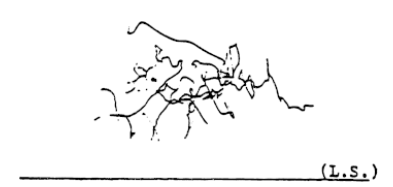
And if you’re a Florida probate litigator there’s another reason why American Scoundrel is a must read. Cohn died less than two months after being disbarred in New York. Cohn was disbarred due in large part to his unethical conduct in attempting to defraud a wealthy client, Lewis S. Rosenstiel, by obtaining Rosenstiel’s “signature” to a will codicil while Rosenstiel lay dying in a Miami Beach hospital room.
The purported signature of Mr. Rosenstiel upon the second codicil has been described as some “squibbly lines.” Certainly an examination of the same discloses nothing more than some lines on the paper at the place for the testator’s signature. No discernible letter of the alphabet appears. …
Lew S. Rosenstiel’s “signature”
In regard to the alleged “signature” by Mr. Rosenstiel … a handwriting expert … testified that the pen marks on the Codicil that purported to be Mr. Rosenstiel’s signature did not resemble anything that he had ever seen in all the years of his experience. He testified that he couldn’t conduct the conventional handwriting analysis because he couldn’t find any legible characters in the “signature.”.
Woodrow “Mac” Melvin’s win
On the winning side of the Rosenstiel trial was a then up and coming Miami probate litigator named Woodrow “Mac” Melvin. Mac won this case in 1976. Mac then went on to have a long and storied carrier litigating multiple blockbuster probate cases.
I’ve long admired Mac and have had the good fortune to work with him over the years. Which is why I was delighted the authors of American Scoundrel interviewed Mac at length for this critical chapter in Cohn’s ultimate undoing.
A chilling detail shared by Mac in his recounting of the Rosenstiel trial was Cohn’s blatant attempt to influence the Miami probate judge with the corroborating testimony of Cohn’s “old friend” Lew Nichols … who just happened to be the former deputy director of the FBI! Cohn’s ploy ultimately failed, due in large part to Mac’s excellent lawyering.
[Mac Melvin] … knew Rosenstiel had severe dementia and many other ailments. “But here is the (former) assistant director of the FBI,” Melvin later said, “saying he has lucid moments. And under the law, a person can be partially incompetent… that was Roy’s whole case, that he was in terrible shape, but he was in great shape the day he signed this codicil.” Melvin always remembered Nichols’s testimony as “the most stunning display of behind-the-scenes power that I’ve ever seen in my life.” It seemed obvious that Roy had suborned perjury from Nichols. “I could not come to any other conclusion,” Melvin said.
Melvin counterpunched with all the medical evidence showing Rosenstiel’s true condition. And in the end the medical records trumped Nichols’s testimony. In a rare defeat, Cohn’s gambit failed. On June 24, 1976, Judge Frank Dowling revoked the codicil on the grounds that Rosenstiel was clearly not in possession of his full mental faculties. The judge ruled that “Roy M. Cohn misrepresented… the nature, content and purpose of the document that he offered to Mr. Rosenstiel.” Roy shrugged off the judgement and denied everything: “If that’s what the judge says, that’s fine. But I was there [in the hospital room] and the judge wasn’t.” He issued a press statement attacking the “Southern judge.”
His show of bravado was impressive, but the Florida court had technically ruled him guilty of civil fraud. A year later, the New York Bar Association’s Committee on Grievances received a formal complaint based on Judge Dowling’s finding of fraud. Cohn was asked to explain himself. He found plenty of excuses to delay the inquiry which dragged on for the next nine years. But eventually the Rosenstiel codicil case would become a key element in a disbarment hearing.
Roy Cohn’s downfall
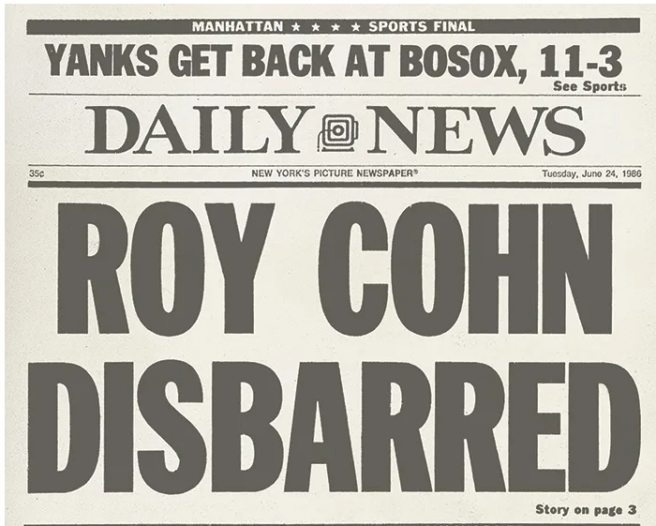
Mac’s victory in the Rosenstiel trial would go on to play a critical role in Roy Cohn’s eventual disbarment, which made national headlines as reported by Time Magazine, the New York Times, and UPI, among others. Here’s an excerpt from the New York court’s ruling disbarring Cohn:
At the very least, it was highly unethical for [Cohn] to have persisted in procuring the execution of a testamentary instrument from a hospitalized patient of questionable mental capacity, especially after being told by hospital and nursing staff members that such actions were against hospital policy and should not be done without the presence of a hospital administrator or a member of the patient’s family. … [Cohn’s] role in the execution and witnessing of this document made his conduct particularly reprehensible in light of the fact that this codicil was designed to give him, inter alia, a personal interest as coexecutor of the testator’s sizeable estate. …
It strains credulity for [Cohn] to argue that all the testimonial references by the hospital staff witnesses … had been manufactured out of whole cloth. … [Cohn] cannot now deny that the main purpose of his visit that morning was to effect the execution of the codicil. In this respect, we find [Cohn’s] testimony with regard to events in the hospital room … to have been untruthful, misleading, and evidence of highly unprofessional conduct for an attorney-at-law.
What’s the takeaway?
If you’re a probate litigator, the Rosenstiel trial brings home the lasting impact of what we do to the people involved. Our cases rarely draw national headlines (but sometimes they do). For Roy Cohn, the Rosenstiel trial was likely insignificant when it took place. Cohn probably thought, “who cares what some probate judge down in Miami has to say about anything.”
In the 1970s Cohn was a man riding high on his own celebrity and power-broker status. But even Cohn couldn’t bend reality to his will forever. Eventually, the facts established in a Miami probate trial caught up with him. Facts matter.
I asked Mac if I could interview him about his experiences in the Rosenstiel case and his thoughts on how it was reported in American Scoundrel. Mac graciously agreed. I’ll post Mac’s interview as soon as it’s completed. Stay tuned for more …